 |
| Music |
| Songs |
| Song Years |
| Song Artists |
| Song Titles |
| Song Charts |
| Albums |
| Album Years |
| Album Artists |
| Album Charts |
| Site Index |
Which albums had the highest number of worldwide sales? |
|
As has been mentioned elsewhere this site focus on success in the source charts, not on estimates of sales. In our experience most quoted sales figures are inherently untrustworthy and should normally be treated with extreme caution. However there are some music industry based organisations that are responsible for defining official "achievement levels" (like Gold and Platinum sales for example). The audits of these organisations can be trusted as evidence of sales numbers and from these we can calculate a guaranteed minimum number of sales for each album that is audited (in millions). Of course many albums have not been analysed in this way, their absence from these lists indicates only that no-one has paid for them to be audited, not that they didn't sell the required number of copies. In particular albums from the 1950s or 1960s are noticeably absent, even though a historical review would appear to suggest they should have sufficient sales. There are a number of other issues that affect these numbers, they are described in detail following the table.
This table also includes a calculation, that is our estimate of the most probable level of worldwide sales. Like all such estimates this number should be treated with some caution, we have also included a range of possible values to indicate the uncertainty of the figure. For example, our estimate of the sales of "Thriller" are in the range 48-65 million.
| # | Artist | Album Title | US (RIAA) | UK (BPI) | France (SNEP) | Germany (BMi) | Minimal | Probable | Range |
| 1 | Michael Jackson | Thriller | 27 X Platinum | 11 x Platinum | 3 x Platinum | 30.9 | 56.1 | 48 - 65 | |
| 2 | Led Zeppelin | Four Symbols (Led Zeppelin 4) | 23 X Platinum | 6 x Platinum | 2 X Platinum | Platinum | 25.4 | 44.5 | 38 - 51 |
| 3 | Eagles | Eagles' Greatest Hits 1971-1975 | 29 X Platinum | Silver | 29.1 | 42.9 | 38 - 48 | ||
| 4 | Shania Twain | Come On Over | 20 X Platinum | 10 x Platinum | Platinum | Platinum | 23.4 | 42.7 | 36 - 50 |
| 5 | Pink Floyd | The Wall | 23 X Platinum | Platinum | 4 x Platinum | 24.1 | 41.8 | 36 - 48 | |
| 6 | AC/DC | Back In Black | 22 X Platinum | Gold | 2 X Platinum | 2 x Platinum | 22.9 | 39.0 | 34 - 45 |
| 7 | Alanis Morissette | Jagged Little Pill | 16 X Platinum | 10 x Platinum | Platinum | 2 x Platinum | 19.6 | 38.6 | 32 - 45 |
| 8 | Whitney Houston | The Bodyguard | 17 X Platinum | 7 x Platinum | 3 x Platinum | 19.7 | 37.3 | 31 - 43 | |
| 9 | Pink Floyd | Dark Side Of The Moon | 15 X Platinum | 9 x Platinum | 2 x Platinum | 18.1 | 34.7 | 29 - 40 | |
| 10 | Abba | Gold, Greatest Hits | 6 X Platinum | 13 x Platinum | Diamond | 4 x Platinum | 11.5 | 34.4 | 27 - 42 |
| 11 | Dire Straits | Brothers In Arms | 9 X Platinum | 13 x Platinum | Diamond | Platinum | 13.9 | 33.6 | 27 - 40 |
| 12 | Fleetwood Mac | Rumours | 19 X Platinum | Gold | Platinum | 2 x Platinum | 19.7 | 33.2 | 29 - 38 |
| 13 | Celine Dion | Falling Into You | 11 X Platinum | 7 x Platinum | Diamond | 2 x Platinum | 14.3 | 32.2 | 26 - 38 |
| 14 | Billy Joel | Billy Joel's Greatest Hits, Volume I & Volume II | 21 X Platinum | Platinum | 21.3 | 31.9 | 28 - 36 | ||
| 14 | Michael Jackson | Bad | 8 X Platinum | 13 x Platinum | 4 x Platinum | 12.7 | 31.9 | 26 - 39 | |
| 16 | Madonna | The Immaculate Collection | 10 X Platinum | 12 x Platinum | 2 X Platinum | Platinum | 14.2 | 31.5 | 26 - 38 |
| 16 | The Beatles | 1 | 10 X Platinum | 8 x Platinum | 5 x Platinum | 13.4 | 31.5 | 26 - 38 | |
| 18 | Celine Dion | Let's Talk About Love | 10 X Platinum | 6 x Platinum | Diamond | 3 x Platinum | 13.2 | 31.4 | 25 - 38 |
| 19 | Eagles | Hotel California | 16 X Platinum | 6 x Platinum | Platinum | 18.0 | 31.4 | 27 - 36 | |
| 20 | Norah Jones | Come Away With Me | 10 X Platinum | 7 x Platinum | Diamond | 2 x Platinum | 13.3 | 30.7 | 25 - 37 |
| 21 | Guns n' Roses | Appetite For Destruction | 18 X Platinum | 2 x Platinum | 2 X Gold | Gold | 18.9 | 30.4 | 27 - 35 |
| 22 | Santana | Supernatural | 15 X Platinum | 2 x Platinum | 2 X Platinum | 2 x Platinum | 16.4 | 30.4 | 26 - 35 |
| 23 | The Beatles | The Beatles 1962-1966 | 15 X Platinum | Platinum | 4 x Platinum | 16.1 | 30.0 | 25 - 35 | |
| 24 | The Beatles | The Beatles 1967-1970 | 16 X Platinum | Platinum | 3 x Platinum | 16.9 | 29.8 | 26 - 34 | |
| 25 | Meat Loaf | Bat Out Of Hell | 14 X Platinum | 7 x Platinum | Platinum | 16.3 | 29.4 | 25 - 34 | |
| 26 | Tracy Chapman | Tracy Chapman | 6 X Platinum | 8 x Platinum | Diamond | 4 x Platinum | 10.0 | 29.3 | 23 - 36 |
| 27 | Phil Collins | No Jacket Required | 12 X Platinum | 6 x Platinum | 3 x Platinum | 14.4 | 28.9 | 24 - 34 | |
| 28 | Mariah Carey | Music Box | 10 X Platinum | 5 x Platinum | Diamond | 2 x Platinum | 12.7 | 28.7 | 23 - 34 |
| 29 | Bruce Springsteen | Born In The USA | 15 X Platinum | 3 x Platinum | 2 x Platinum | 16.3 | 28.6 | 25 - 33 | |
| 30 | Bee Gees | Saturday Night Fever | 15 X Platinum | Platinum | 3 x Platinum | 15.9 | 28.3 | 24 - 33 | |
| 31 | Britney Spears | Baby One More Time | 14 X Platinum | 3 x Platinum | 2 X Platinum | Platinum | 15.5 | 28.3 | 24 - 33 |
| 32 | Original Soundtrack | Dirty Dancing | 11 X Platinum | 5 x Platinum | 4 x Platinum | 13.3 | 28.2 | 23 - 33 | |
| 33 | Celine Dion & James Horner | Titanic | 11 X Platinum | 3 x Platinum | Diamond | 2 x Platinum | 13.1 | 28.1 | 23 - 33 |
| 34 | Bob Marley | Legend, The Best Of Bob Marley | 10 X Platinum | 6 x Platinum | Diamond | Platinum | 12.8 | 27.9 | 23 - 33 |
| 35 | Spice Girls | Spice | 7 X Platinum | 10 x Platinum | Diamond | Platinum | 11.0 | 27.6 | 22 - 33 |
| 36 | Led Zeppelin | Physical Graffiti | 16 X Platinum | 2 x Platinum | Gold | 16.7 | 26.4 | 23 - 30 | |
| 37 | Madonna | True Blue | 7 X Platinum | 7 x Platinum | Diamond | 2 x Platinum | 10.3 | 26.3 | 21 - 32 |
| 38 | Nirvana | Nevermind | 10 X Platinum | 2 x Platinum | Diamond | 2 x Platinum | 11.8 | 25.6 | 21 - 30 |
| 39 | James Blunt | Back To Bedlam | 2 X Platinum | 10 x Platinum | Diamond | 4 x Platinum | 6.6 | 25.4 | 19 - 32 |
| 40 | U2 | The Joshua Tree | 10 X Platinum | 6 x Platinum | 2 X Gold | 2 x Platinum | 12.4 | 25.3 | 21 - 30 |
| 41 | Boston | Boston | 17 X Platinum | Gold | 17.1 | 25.3 | 23 - 28 | ||
| 42 | Simon & Garfunkel | Simon & Garfunkel's Greatest Hits | 14 X Platinum | Platinum | 2 x Platinum | 14.7 | 25.1 | 22 - 29 | |
| 43 | Michael Jackson | History - Past, Present & Future, Book 1 | 7 X Platinum | 4 x Platinum | Diamond | 3 x Platinum | 9.6 | 25.0 | 20 - 30 |
| 44 | Whitney Houston | Whitney Houston | 13 X Platinum | 4 x Platinum | Platinum | 14.4 | 24.9 | 21 - 29 | |
| 45 | Eminem | The Marshall Mathers LP | 9 X Platinum | 5 x Platinum | 2 X Platinum | 2 x Platinum | 11.3 | 24.7 | 20 - 29 |
| 46 | Elton John | Elton John's Greatest Hits | 16 X Platinum | Platinum | 16.3 | 24.5 | 22 - 27 | ||
| 47 | Led Zeppelin | Led Zeppelin 2 | 12 X Platinum | 4 x Platinum | 2 X Gold | Platinum | 13.6 | 24.5 | 21 - 28 |
| 48 | Phil Collins | ... But Seriously | 4 X Platinum | 8 x Platinum | 6 x Platinum | 7.6 | 24.4 | 19 - 30 | |
| 49 | Eric Clapton | Unplugged | 10 X Platinum | 3 x Platinum | 2 X Platinum | 2 x Platinum | 11.7 | 24.1 | 20 - 28 |
| 50 | Britney Spears | Oops!... I Did It Again | 10 X Platinum | 3 x Platinum | 2 X Gold | 3 x Platinum | 11.7 | 24.0 | 20 - 28 |
| 51 | Hootie & The Blowfish | Cracked Rear View | 16 X Platinum | Gold | 16.1 | 23.9 | 21 - 27 | ||
| 52 | Linkin Park | Hybrid Theory | 10 X Platinum | 4 x Platinum | Platinum | 2 x Platinum | 11.8 | 23.7 | 20 - 28 |
| 53 | ZZ Top | Eliminator | 10 X Platinum | 4 x Platinum | 2 X Platinum | Platinum | 11.8 | 23.4 | 20 - 27 |
| 54 | Metallica | Metallica | 14 X Platinum | Platinum | Platinum | 14.5 | 23.3 | 20 - 26 | |
| 55 | Michael Jackson | Dangerous | 7 X Platinum | 6 x Platinum | 4 x Platinum | 9.6 | 23.3 | 19 - 28 | |
| 56 | Shania Twain | Up | 11 X Platinum | 2 x Platinum | Platinum | 2 x Platinum | 12.2 | 23.1 | 20 - 27 |
| 57 | Prince | Purple Rain | 13 X Platinum | 2 x Platinum | Platinum | 13.8 | 22.9 | 20 - 26 | |
| 58 | The Backstreet Boys | Backstreet Boys | 14 X Platinum | Gold | Platinum | 14.3 | 22.7 | 20 - 26 | |
| 59 | Bon Jovi | Slippery When Wet | 12 X Platinum | 3 x Platinum | Platinum | 13.1 | 22.4 | 19 - 26 | |
| 60 | Oasis | (What's The Story) Morning Glory? | 4 X Platinum | 14 x Platinum | Platinum | Gold | 8.5 | 22.4 | 18 - 27 |
| 61 | Madonna | Like A Virgin | 10 X Platinum | 3 x Platinum | 2 X Platinum | Platinum | 11.5 | 22.4 | 19 - 26 |
| 62 | Dido | No Angel | 4 X Platinum | 9 x Platinum | Diamond | Platinum | 7.7 | 22.2 | 17 - 27 |
| 63 | The Backstreet Boys | Millennium | 13 X Platinum | Platinum | Platinum | 13.5 | 21.9 | 19 - 25 | |
| 64 | Madonna | Ray Of Light | 4 X Platinum | 6 x Platinum | 3 X Platinum | 3 x Platinum | 7.0 | 21.5 | 17 - 27 |
| 65 | Mariah Carey | Daydream | 10 X Platinum | 2 x Platinum | 2 X Platinum | Platinum | 11.2 | 21.4 | 18 - 25 |
| 66 | Whitney Houston | Whitney | 9 X Platinum | 6 x Platinum | Platinum | 11.0 | 21.1 | 18 - 25 | |
| 67 | Bruce Springsteen | Live 1975-1985 | 13 X Platinum | Gold | Gold | Gold | 13.3 | 20.9 | 18 - 24 |
| 68 | Coldplay | X & Y | 3 X Platinum | 8 x Platinum | 2 X Platinum | 3 x Platinum | 6.4 | 20.6 | 16 - 26 |
| 69 | The Cranberries | No Need To Argue | 7 X Platinum | 3 x Platinum | Diamond | Platinum | 8.9 | 20.5 | 17 - 25 |
| 70 | Eminem | The Eminem Show | 8 X Platinum | 4 x Platinum | 2 X Platinum | Platinum | 9.8 | 20.4 | 17 - 24 |
| 70 | U2 | Achtung Baby | 8 X Platinum | 4 x Platinum | 2 X Platinum | Platinum | 9.8 | 20.4 | 17 - 24 |
| 72 | Green Day | Dookie | 10 X Platinum | 3 x Platinum | Gold | Platinum | 11.2 | 20.0 | 17 - 23 |
| 73 | The Fugees | The Score | 6 X Platinum | 4 x Platinum | Diamond | Platinum | 8.2 | 20.0 | 16 - 24 |
| 74 | Original Soundtrack | Top Gun | 9 X Platinum | 2 x Platinum | 2 X Platinum | Platinum | 10.2 | 19.9 | 17 - 23 |
| 75 | Def Leppard | Hysteria | 12 X Platinum | 2 x Platinum | 12.6 | 19.7 | 17 - 22 | ||
| 75 | The Rolling Stones | Hot Rocks - The Greatest Hits 1964-1971 | 12 X Platinum | 2 x Platinum | 12.6 | 19.7 | 17 - 22 | ||
| 77 | Genesis | We Can't Dance | 4 X Platinum | 5 x Platinum | 5 x Platinum | 6.5 | 19.6 | 15 - 24 | |
| 77 | George Michael | Faith | 10 X Platinum | 4 x Platinum | Gold | 11.3 | 19.6 | 17 - 23 | |
| 79 | The Beatles | Abbey Road | 12 X Platinum | Platinum | 12.2 | 19.4 | 17 - 22 | ||
| 80 | Led Zeppelin | Houses Of The Holy | 11 X Platinum | Platinum | 2 X Gold | Gold | 11.6 | 19.1 | 17 - 22 |
| 81 | Boyz II Men | II | 12 X Platinum | Platinum | 12.2 | 19.1 | 17 - 21 | ||
| 82 | Outkast | Speakerboxx & The Love Below | 11 X Platinum | 2 x Platinum | Gold | 11.7 | 19.1 | 17 - 22 | |
| 83 | Celine Dion | All The Way... A Decade Of Songs | 7 X Platinum | 2 x Platinum | Platinum | 3 x Platinum | 8.4 | 19.0 | 15 - 23 |
| 84 | Pearl Jam | Ten | 12 X Platinum | Gold | Gold | 12.2 | 18.9 | 17 - 21 | |
| 85 | Shania Twain | The Woman In Me | 12 X Platinum | Platinum | 12.3 | 18.7 | 17 - 21 | ||
| 86 | Lionel Richie | Can't Slow Down | 10 X Platinum | 3 x Platinum | Gold | 11.0 | 18.6 | 16 - 21 | |
| 87 | Original Soundtrack | Forrest Gump | 12 X Platinum | Gold | Gold | 12.2 | 18.5 | 16 - 21 | |
| 88 | Evanescence | Fallen | 7 X Platinum | 3 x Platinum | Platinum | 2 x Platinum | 8.5 | 18.3 | 15 - 22 |
| 89 | Elton John | The Very Best Of Elton John | 9 x Platinum | Diamond | 2 x Platinum | 3.9 | 18.0 | 13 - 23 | |
| 90 | Green Day | American Idiot | 5 X Platinum | 6 x Platinum | 2 X Gold | 2 x Platinum | 7.4 | 18.0 | 14 - 22 |
| 91 | Kenny G | Breathless | 12 X Platinum | Gold | 12.1 | 18.0 | 16 - 20 | ||
| 92 | The Beatles | Sgt Pepper's Lonely Hearts Club Band | 11 X Platinum | Platinum | 11.2 | 17.9 | 16 - 20 | ||
| 93 | The Dixie Chicks | Wide Open Spaces | 12 X Platinum | Silver | 12.1 | 17.9 | 16 - 20 | ||
| 94 | Usher | Confessions | 9 X Platinum | 4 x Platinum | Gold | 10.3 | 17.8 | 15 - 20 | |
| 95 | No Doubt | Tragic Kingdom | 10 X Platinum | Platinum | 2 X Gold | Gold | 10.6 | 17.7 | 15 - 20 |
| 96 | Phil Collins | Face Value | 5 X Platinum | 5 x Platinum | 3 x Platinum | 7.1 | 17.6 | 14 - 21 | |
| 97 | MC Hammer | Please Hammer Don't Hurt 'Em | 10 X Platinum | 2 x Platinum | Gold | 10.7 | 17.6 | 15 - 20 | |
| 98 | N Sync | No Strings Attached | 11 X Platinum | Gold | Gold | 11.2 | 17.4 | 15 - 20 | |
| 99 | REM | Out Of Time | 4 X Platinum | 5 x Platinum | 2 X Platinum | 2 x Platinum | 6.3 | 17.3 | 14 - 21 |
| 100 | TLC | Crazysexycool | 11 X Platinum | Platinum | 11.3 | 17.2 | 15 - 19 | ||
| 101 | Avril Lavigne | Let Go | 6 X Platinum | 5 x Platinum | Platinum | Platinum | 7.9 | 17.1 | 14 - 20 |
| 102 | Enya | A Day Without Rain | 7 X Platinum | Platinum | Gold | 3 x Platinum | 8.0 | 17.1 | 14 - 20 |
| 103 | Creed | Human Clay | 11 X Platinum | Gold | 11.1 | 17.0 | 15 - 19 | ||
| 104 | Norah Jones | Feels Like Home | 4 X Platinum | 3 x Platinum | 2 X Platinum | 3 x Platinum | 5.9 | 17.0 | 13 - 21 |
| 105 | Meat Loaf | Bat Out Of Hell II, Back Into Hell | 5 X Platinum | 6 x Platinum | 2 x Platinum | 7.2 | 16.9 | 14 - 20 | |
| 106 | REM | Automatic For The People | 4 X Platinum | 6 x Platinum | Platinum | 2 x Platinum | 6.4 | 16.9 | 13 - 21 |
| 107 | Van Halen | 1984 (mcmlxxxiv) | 10 X Platinum | Gold | Platinum | 10.3 | 16.8 | 15 - 19 | |
| 108 | Destiny's Child | The Writing's On The Wall | 8 X Platinum | 3 x Platinum | 2 X Gold | Gold | 9.2 | 16.8 | 14 - 19 |
| 109 | Robbie Williams | Intensive Care | 5 x Platinum | 2 X Platinum | 5 x Platinum | 2.9 | 16.6 | 12 - 21 | |
| 110 | Simply Red | Stars | Gold | 12 x Platinum | 2 x Platinum | 4.5 | 16.4 | 12 - 21 | |
| 111 | Kid Rock | Devil Without A Cause | 11 X Platinum | Silver | 11.1 | 16.4 | 15 - 18 | ||
| 112 | Queen | Queen's Greatest Hits I | 11 x Platinum | 3 x Platinum | 3.9 | 16.4 | 12 - 21 | ||
| 113 | Will Smith | Big Willie Style | 9 X Platinum | 2 x Platinum | 2 X Gold | 9.8 | 16.3 | 14 - 19 | |
| 114 | Robbie Williams | Swing When You're Winning | 7 x Platinum | Gold | 5 x Platinum | 3.2 | 16.3 | 12 - 21 | |
| 115 | Original Soundtrack | Grease: The Original Soundtrack | 8 X Platinum | Platinum | 2 x Platinum | 8.7 | 16.3 | 14 - 19 | |
| 116 | Guns n' Roses | Use Your Illusion I | 7 X Platinum | Platinum | Platinum | 2 x Platinum | 7.9 | 16.2 | 13 - 19 |
| 117 | Celine Dion | The Colour Of My Love | 6 X Platinum | 5 x Platinum | Platinum | Gold | 7.8 | 16.2 | 13 - 19 |
| 118 | Neil Young | Harvest | 4 X Platinum | 3 x Platinum | Diamond | Platinum | 5.9 | 16.1 | 13 - 20 |
| 119 | Fleetwood Mac | Tango In The Night | 3 X Platinum | 8 x Platinum | 2 x Platinum | 5.8 | 16.0 | 13 - 20 | |
| 120 | Simon & Garfunkel | Bridge Over Troubled Water | 8 X Platinum | Platinum | Platinum | Platinum | 8.7 | 16.0 | 14 - 18 |
| 121 | Tom Petty & The Heartbreakers | Tom Petty & The Heartbreakers' Greatest Hits | 10 X Platinum | Gold | Gold | 10.2 | 15.9 | 14 - 18 | |
| 121 | Van Halen | Van Halen | 10 X Platinum | Gold | Gold | 10.2 | 15.9 | 14 - 18 | |
| 123 | Bon Jovi | Crossroad - The Best Of Bon Jovi | 4 X Platinum | 5 x Platinum | Platinum | 2 x Platinum | 6.1 | 15.9 | 13 - 19 |
| 124 | Madonna | Music | 3 X Platinum | 5 x Platinum | 2 X Platinum | 2 x Platinum | 5.3 | 15.8 | 12 - 20 |
| 125 | Michael Bolton | Time, Love & Tenderness | 8 X Platinum | 4 x Platinum | 9.2 | 15.8 | 14 - 18 | ||
| 126 | Coldplay | A Rush Of Blood To The Head | 4 X Platinum | 7 x Platinum | 2 X Gold | Platinum | 6.5 | 15.8 | 13 - 19 |
| 127 | Stevie Wonder | Songs In The Key Of Life | 10 X Platinum | Platinum | 10.3 | 15.7 | 14 - 18 | ||
| 128 | The Smashing Pumpkins | Mellon Collie & The Infinite Sadness | 9 X Platinum | Platinum | Platinum | 9.5 | 15.7 | 14 - 18 | |
| 129 | 2Pac | 2Pac's Greatest Hits | 9 X Platinum | Platinum | Gold | Gold | 9.5 | 15.7 | 14 - 18 |
| 130 | Paul Simon | Graceland | 5 X Platinum | 5 x Platinum | Platinum | Platinum | 6.9 | 15.6 | 13 - 19 |
| 131 | N Sync | 'N Sync | 10 X Platinum | Gold | 10.1 | 15.6 | 14 - 17 | ||
| 131 | Spice Girls | Spiceworld | 4 X Platinum | 5 x Platinum | 2 X Platinum | Platinum | 6.1 | 15.6 | 12 - 19 |
| 133 | Disney | The Lion King | 10 X Platinum | Silver | Gold | 10.1 | 15.4 | 14 - 17 | |
| 134 | Amy Winehouse | Back to Black | 2 X Platinum | 6 x Platinum | 2 X Platinum | 2 x Platinum | 4.6 | 15.4 | 12 - 19 |
| 135 | Bryan Adams | So Far So Good | 5 X Platinum | 3 x Platinum | Platinum | 2 x Platinum | 6.5 | 15.3 | 12 - 18 |
| 136 | Phil Collins | Serious Hits, Live! | 4 X Platinum | 4 x Platinum | 3 x Platinum | 5.8 | 15.1 | 12 - 18 | |
| 137 | Queen | Greatest Hits II | 8 x Platinum | 4 x Platinum | 3.2 | 15.1 | 11 - 19 | ||
| 138 | Alicia Keys | Songs In 'A' Minor | 6 X Platinum | 3 x Platinum | Platinum | Platinum | 7.3 | 15.0 | 12 - 18 |
| 138 | Billy Joel | The Stranger | 10 X Platinum | Gold | 10.1 | 15.0 | 13 - 17 | ||
| 138 | Garth Brooks | The Hits | 10 X Platinum | Gold | 10.1 | 15.0 | 13 - 17 | ||
| 141 | Def Leppard | Pyromania | 10 X Platinum | Silver | 10.1 | 14.9 | 13 - 17 | ||
| 141 | Garth Brooks | Sevens | 10 X Platinum | Silver | 10.1 | 14.9 | 13 - 17 | ||
| 141 | The Doobie Brothers | Best Of The Doobies | 10 X Platinum | Silver | 10.1 | 14.9 | 13 - 17 | ||
| 141 | The Doors | The Best Of The Doors | 10 X Platinum | Silver | 10.1 | 14.9 | 13 - 17 | ||
| 145 | Lauryn Hill | The Miseducation Of Lauryn Hill | 8 X Platinum | 2 x Platinum | 2 X Gold | 8.8 | 14.9 | 13 - 17 | |
| 146 | Guns n' Roses | Use Your Illusion II | 7 X Platinum | Platinum | 2 x Platinum | 7.7 | 14.8 | 12 - 17 | |
| 147 | R Kelly | R. | 8 X Platinum | Platinum | 2 X Gold | Gold | 8.6 | 14.7 | 13 - 17 |
| 148 | New Kids On The Block | Hangin' Tough | 8 X Platinum | 2 x Platinum | Gold | 8.7 | 14.7 | 13 - 17 | |
| 148 | The Beatles | Anthology 1 | 8 X Platinum | 2 x Platinum | Gold | 8.7 | 14.7 | 13 - 17 | |
| 150 | Original Soundtrack | Footloose | 9 X Platinum | Gold | 2 X Gold | 9.3 | 14.7 | 13 - 17 | |
| 151 | Genesis | Invisible Touch | 6 X Platinum | 4 x Platinum | Platinum | 7.4 | 14.6 | 12 - 17 | |
| 151 | Kelly Clarkson | Breakaway | 6 X Platinum | 4 x Platinum | Platinum | 7.4 | 14.6 | 12 - 17 | |
| 153 | Madonna | Like A Prayer | 4 X Platinum | 4 x Platinum | 2 X Platinum | Platinum | 5.8 | 14.6 | 12 - 18 |
| 154 | Red Hot Chili Peppers | Blood Sugar Sex Magik | 7 X Platinum | Platinum | Platinum | Platinum | 7.7 | 14.5 | 12 - 17 |
| 155 | Robbie Williams | Escapology | 6 x Platinum | Platinum | 4 x Platinum | 2.8 | 14.5 | 11 - 19 | |
| 155 | Robbie Williams | Robbie Williams' Greatest Hits | 6 x Platinum | Platinum | 4 x Platinum | 2.8 | 14.5 | 11 - 19 | |
| 157 | Madonna | Confessions On A Dance Floor | Platinum | 4 x Platinum | Diamond | 2 x Platinum | 3.4 | 14.4 | 11 - 18 |
| 158 | Toni Braxton | Secrets | 8 X Platinum | 2 x Platinum | Gold | 8.7 | 14.3 | 12 - 16 | |
| 159 | Moby | Play | 2 X Platinum | 5 x Platinum | Diamond | Gold | 4.4 | 14.3 | 11 - 18 |
| 160 | Linkin Park | Meteora | 4 X Platinum | 2 x Platinum | 2 X Platinum | 2 x Platinum | 5.4 | 14.3 | 11 - 17 |
| 161 | Mariah Carey | Mariah Carey | 9 X Platinum | Platinum | 9.3 | 14.3 | 13 - 16 | ||
| 162 | Nickelback | Silver Side Up | 6 X Platinum | 3 x Platinum | Gold | Platinum | 7.2 | 14.1 | 12 - 17 |
| 163 | Andrew Lloyd Webber | Phantom Of The Opera | 4 X Platinum | 3 x Platinum | 3 x Platinum | 5.5 | 14.1 | 11 - 17 | |
| 164 | Bon Jovi | New Jersey | 7 X Platinum | 2 x Platinum | Platinum | 7.8 | 14.1 | 12 - 16 | |
| 165 | Shakira | Fijacion oral - Vol. 1 | 8 X Platinum | Gold | Platinum | 8.3 | 14.0 | 12 - 16 | |
| 166 | The Eurythmics | The Eurythmics' Greatest Hits | 3 X Platinum | 6 x Platinum | 2 x Platinum | 5.2 | 14.0 | 11 - 17 | |
| 167 | Tina Turner | Private Dancer | 5 X Platinum | 3 x Platinum | 2 x Platinum | 6.3 | 13.9 | 11 - 17 | |
| 168 | The Backstreet Boys | Black & Blue | 8 X Platinum | Gold | Platinum | 8.3 | 13.8 | 12 - 16 | |
| 169 | Phil Collins | Hello, I Must Be Going! | 3 X Platinum | 3 x Platinum | 2 X Platinum | 2 x Platinum | 4.7 | 13.8 | 11 - 17 |
| 170 | Led Zeppelin | Led Zeppelin | 8 X Platinum | 2 x Platinum | 8.6 | 13.8 | 12 - 16 | ||
| 171 | Maroon 5 | Songs About Jane | 4 X Platinum | 5 x Platinum | 2 X Gold | Platinum | 5.9 | 13.8 | 11 - 17 |
| 172 | Wham! | Make It Big | 6 X Platinum | 4 x Platinum | Gold | 7.3 | 13.8 | 12 - 16 | |
| 173 | U2 | Rattle & Hum | 5 X Platinum | 4 x Platinum | Gold | Platinum | 6.5 | 13.7 | 11 - 16 |
| 174 | The Police | Synchronicity | 8 X Platinum | Platinum | Gold | 8.4 | 13.6 | 12 - 15 | |
| 175 | Nelly Furtado | Loose | Platinum | 2 x Platinum | Platinum | 5 x Platinum | 2.8 | 13.6 | 10 - 17 |
| 176 | Aerosmith | Get A Grip | 7 X Platinum | Platinum | Gold | Platinum | 7.6 | 13.6 | 12 - 16 |
| 177 | Billy Ray Cyrus | Some Gave All | 9 X Platinum | Gold | 9.1 | 13.6 | 12 - 15 | ||
| 177 | Boyz II Men | Cooleyhighharmony | 9 X Platinum | Gold | 9.1 | 13.6 | 12 - 15 | ||
| 177 | The Beastie Boys | Licensed To Ill | 9 X Platinum | Gold | 9.1 | 13.6 | 12 - 15 | ||
| 180 | Pink | Missundaztood | 5 X Platinum | 5 x Platinum | 2 X Gold | 6.7 | 13.5 | 11 - 16 | |
| 181 | Santana | Santana's Greatest Hits | 7 X Platinum | Gold | 2 X Gold | Platinum | 7.5 | 13.4 | 11 - 16 |
| 182 | 2Pac | All Eyez On Me | 9 X Platinum | Silver | 9.1 | 13.4 | 12 - 15 | ||
| 182 | Nelly | Country Grammar | 9 X Platinum | Silver | 9.1 | 13.4 | 12 - 15 | ||
| 182 | REO Speedwagon | Hi Infidelity | 9 X Platinum | Silver | 9.1 | 13.4 | 12 - 15 | ||
| 185 | Billy Joel | An Innocent Man | 7 X Platinum | 3 x Platinum | 7.9 | 13.3 | 12 - 15 | ||
| 186 | Red Hot Chili Peppers | Californication | 5 X Platinum | 3 x Platinum | 2 X Gold | Platinum | 6.3 | 13.2 | 11 - 16 |
| 187 | Savage Garden | Savage Garden | 7 X Platinum | 2 x Platinum | Gold | 7.7 | 13.2 | 11 - 15 | |
| 188 | Phil Collins | ... Hits | 3 X Platinum | 4 x Platinum | 2 X Platinum | Platinum | 4.8 | 13.1 | 10 - 16 |
| 189 | Dido | Life For Rent | 2 X Platinum | 7 x Platinum | 2 X Platinum | 4.5 | 12.9 | 10 - 16 | |
| 190 | Queen | Made In Heaven | Gold | 4 x Platinum | 2 X Platinum | 3 x Platinum | 2.7 | 12.9 | 10 - 16 |
| 190 | Michael Bolton | Soul Provider | 6 X Platinum | 4 x Platinum | 7.2 | 12.9 | 11 - 15 | ||
| 192 | Sheryl Crow | Tuesday Night Music Club | 7 X Platinum | 2 x Platinum | Gold | 7.7 | 12.9 | 11 - 15 | |
| 193 | Metallica | ...and Justice For All | 8 X Platinum | Silver | Gold | 8.2 | 12.8 | 11 - 14 | |
| 194 | Janet Jackson | Janet | 6 X Platinum | 2 x Platinum | 2 X Gold | Gold | 6.9 | 12.8 | 11 - 15 |
| 195 | Shakira | Laundry Service | 3 X Platinum | 2 x Platinum | 2 X Platinum | 2 x Platinum | 4.4 | 12.8 | 10 - 16 |
| 196 | Enya | Watermark | 4 X Platinum | 4 x Platinum | 2 X Gold | Platinum | 5.6 | 12.8 | 10 - 15 |
| 197 | Michael Jackson | Off The Wall | 7 X Platinum | Platinum | Platinum | 7.5 | 12.8 | 11 - 15 | |
| 198 | INXS | Kick | 6 X Platinum | 3 x Platinum | Gold | 7.0 | 12.7 | 11 - 15 | |
| 199 | Ricky Martin | Ricky Martin | 7 X Platinum | Platinum | Gold | Gold | 7.5 | 12.7 | 11 - 15 |
| 200 | Christina Aguilera | Stripped | 4 X Platinum | 5 x Platinum | Platinum | 5.7 | 12.7 | 10 - 15 | |
| 201 | Ace of Base | Happy Nation | 2 x Platinum | Diamond | 3 x Platinum | 2.0 | 12.6 | 9 - 16 | |
| 202 | Crosby, Stills, Nash & Young | Deja Vu | 7 X Platinum | Platinum | Gold | 7.3 | 12.6 | 11 - 14 | |
| 203 | Andrea Bocelli | Romanza | 3 X Platinum | Platinum | Diamond | Platinum | 4.3 | 12.6 | 10 - 15 |
| 204 | Bruce Springsteen | Bruce Springsteen's Greatest Hits | 4 X Platinum | 2 x Platinum | 2 X Gold | 2 x Platinum | 5.2 | 12.5 | 10 - 15 |
| 205 | Shaggy | Hot Shot | 6 X Platinum | 3 x Platinum | Gold | 7.0 | 12.4 | 11 - 14 | |
| 206 | Enigma | MCMXC AD | 4 X Platinum | 3 x Platinum | 2 x Platinum | 5.3 | 12.4 | 10 - 15 | |
| 207 | AC/DC | Highway To Hell | 7 X Platinum | Gold | Platinum | 7.3 | 12.4 | 11 - 14 | |
| 208 | Bobby Brown | Don't Be Cruel | 7 X Platinum | 2 x Platinum | 7.6 | 12.3 | 11 - 14 | ||
| 208 | Nickelback | All The Right Reasons | 7 X Platinum | 2 x Platinum | 7.6 | 12.3 | 11 - 14 | ||
| 210 | Enya | Shepherd Moons | 5 X Platinum | 4 x Platinum | Gold | 6.3 | 12.3 | 10 - 14 | |
| 211 | 50 Cent | Get Rich Or Die Tryin' | 6 X Platinum | 2 x Platinum | Gold | Gold | 6.8 | 12.3 | 10 - 14 |
| 212 | Keane | Hopes & Fears | Gold | 9 x Platinum | Platinum | Gold | 3.5 | 12.2 | 9 - 15 |
| 212 | The Corrs | Talk On Corners | Gold | 9 x Platinum | Platinum | Gold | 3.5 | 12.2 | 9 - 15 |
| 214 | Peter Gabriel | So | 5 X Platinum | 3 x Platinum | Platinum | 6.1 | 12.1 | 10 - 14 | |
| 215 | Offspring | Americana | 5 X Platinum | Platinum | 2 X Platinum | Gold | 5.8 | 12.1 | 10 - 14 |
| 216 | Bob Seger & The Silver Bullet Band | Bob Seger & The Silver Bullet Band's Greatest Hits | 8 X Platinum | Gold | 8.1 | 12.1 | 11 - 14 | ||
| 216 | Christina Aguilera | Christina Aguilera | 8 X Platinum | Gold | 8.1 | 12.1 | 11 - 14 | ||
| 216 | Creedence Clearwater Revival | Chronicle | 8 X Platinum | Gold | 8.1 | 12.1 | 11 - 14 | ||
| 216 | Eagles | Hell Freezes Over | 8 X Platinum | Gold | 8.1 | 12.1 | 11 - 14 | ||
| 216 | Garth Brooks | In Pieces | 8 X Platinum | Gold | 8.1 | 12.1 | 11 - 14 | ||
| 216 | The Rolling Stones | Forty Licks | 4 X Platinum | 3 x Platinum | Platinum | Platinum | 5.3 | 12.1 | 10 - 14 |
| 216 | Toni Braxton | Toni Braxton | 8 X Platinum | Gold | 8.1 | 12.1 | 11 - 14 | ||
| 223 | Robbie Williams | I've Been Expecting You | 10 x Platinum | 2 X Gold | Gold | 3.3 | 12.1 | 9 - 15 | |
| 224 | Elton John | Love Songs | 3 X Platinum | 3 x Platinum | 2 X Platinum | Platinum | 4.5 | 12.1 | 10 - 15 |
| 225 | Coldplay | Parachutes | 2 X Platinum | 7 x Platinum | 2 X Gold | Gold | 4.4 | 12.0 | 9 - 15 |
| 226 | Live | Throwing Copper | 8 X Platinum | Silver | 8.1 | 12.0 | 11 - 13 | ||
| 226 | Stone Temple Pilots | Core | 8 X Platinum | Silver | 8.1 | 12.0 | 11 - 13 | ||
| 228 | Whitney Houston | My Love Is Your Love | 4 X Platinum | 3 x Platinum | 2 X Platinum | 5.3 | 11.8 | 10 - 14 | |
| 229 | George Michael | Ladies & Gentlemen - The Best Of George Michael | 2 X Platinum | 7 x Platinum | Platinum | 4.3 | 11.8 | 9 - 14 | |
| 230 | Destiny's Child | Survivor | 4 X Platinum | 3 x Platinum | 2 X Gold | Platinum | 5.3 | 11.7 | 10 - 14 |
| 230 | Eminem | Encore | 4 X Platinum | 3 x Platinum | 2 X Gold | Platinum | 5.3 | 11.7 | 10 - 14 |
| 230 | REM | Monster | 4 X Platinum | 3 x Platinum | 2 X Gold | Platinum | 5.3 | 11.7 | 10 - 14 |
| 233 | Nelly | Nellyville | 6 X Platinum | 2 x Platinum | Gold | 6.7 | 11.7 | 10 - 13 | |
| 234 | Eagles | The Long Run | 7 X Platinum | Gold | 2 X Gold | 7.3 | 11.7 | 10 - 13 | |
| 235 | Sade | Diamond Life | 4 X Platinum | 4 x Platinum | Platinum | 5.4 | 11.7 | 10 - 14 | |
| 236 | U2 | War | 4 X Platinum | 2 x Platinum | 2 X Platinum | Gold | 5.1 | 11.7 | 9 - 14 |
| 237 | U2 | How To Dismantle An Atomic Bomb | 3 X Platinum | 4 x Platinum | Platinum | Platinum | 4.6 | 11.6 | 9 - 14 |
| 238 | Lionel Richie | Back To Front | Platinum | 4 x Platinum | 3 X Platinum | Platinum | 3.0 | 11.6 | 9 - 15 |
| 239 | Anastacia | Anastacia | 4 x Platinum | Gold | 4 x Platinum | 2.1 | 11.5 | 8 - 15 | |
| 240 | Aerosmith | Pump | 7 X Platinum | Gold | Gold | 7.2 | 11.5 | 10 - 13 | |
| 240 | Jackson Browne | Running On Empty | 7 X Platinum | Gold | Gold | 7.2 | 11.5 | 10 - 13 | |
| 242 | Celine Dion | A New Day Has Come | 3 X Platinum | Platinum | 3 X Platinum | Platinum | 4.1 | 11.5 | 9 - 14 |
| 243 | The Police | Every Breath You Take - The Singles | 5 X Platinum | 4 x Platinum | 6.2 | 11.4 | 10 - 13 | ||
| 244 | Mariah Carey | The Emancipation Of Mimi | 6 X Platinum | 2 x Platinum | Gold | 6.7 | 11.4 | 10 - 13 | |
| 245 | Foreigner | Records | 7 X Platinum | Silver | Gold | 7.2 | 11.4 | 10 - 13 | |
| 245 | Limp Bizkit | Significant Other | 7 X Platinum | Silver | Gold | 7.2 | 11.4 | 10 - 13 | |
| 247 | Tina Turner | Simply The Best | Platinum | 8 x Platinum | Platinum | 3.6 | 11.3 | 9 - 14 | |
| 248 | Elton John | Goodbye Yellow Brick Road | 7 X Platinum | Platinum | 7.3 | 11.3 | 10 - 13 | ||
| 248 | Paula Abdul | Forever Your Girl | 7 X Platinum | Platinum | 7.3 | 11.3 | 10 - 13 | ||
| 248 | Carpenters | The Singles 1969-1973 | 7 X Platinum | Platinum | 7.3 | 11.3 | 10 - 13 | ||
| 248 | Vanilla Ice | To The Extreme | 7 X Platinum | Platinum | 7.3 | 11.3 | 10 - 13 | ||
| 252 | Bryan Adams | Reckless | 5 X Platinum | 3 x Platinum | Gold | 6.0 | 11.3 | 10 - 13 | |
| 252 | Tears For Fears | Songs From The Big Chair | 5 X Platinum | 3 x Platinum | Gold | 6.0 | 11.3 | 10 - 13 | |
| 254 | Nirvana | Unplugged In New York | 5 X Platinum | Platinum | 2 X Platinum | 5.7 | 11.3 | 9 - 13 | |
| 255 | Justin Timberlake | FutureSex / LoveSounds | 4 X Platinum | 3 x Platinum | Platinum | Gold | 5.2 | 11.2 | 9 - 13 |
| 256 | Jose Carreras, Placido Domingo & Luciano Pavarotti | In Concert | 3 X Platinum | 5 x Platinum | Platinum | 4.7 | 11.2 | 9 - 14 | |
| 257 | Red Hot Chili Peppers | By The Way | 2 X Platinum | 5 x Platinum | Platinum | Platinum | 3.9 | 11.2 | 9 - 14 |
| 258 | AC/DC | The Razor's Edge | 5 X Platinum | Gold | 2 x Platinum | 5.5 | 11.2 | 9 - 13 | |
| 258 | Pink | I'm Not Dead | Platinum | 3 x Platinum | Platinum | 3 x Platinum | 2.7 | 11.2 | 8 - 14 |
| 258 | Eagles | Long Road out of Eden | 7 X Platinum | Gold | 7.1 | 11.2 | 10 - 13 | ||
| 261 | Led Zeppelin | Led Zeppelin 3 | 6 X Platinum | Platinum | Gold | 6.3 | 11.1 | 10 - 13 | |
| 262 | Madonna | Evita | 5 X Platinum | 2 x Platinum | Platinum | 5.8 | 11.1 | 9 - 13 | |
| 263 | Sade | Promise | 4 X Platinum | 2 x Platinum | Platinum | Platinum | 5.0 | 11.1 | 9 - 13 |
| 264 | Pink Floyd | The Division Bell | 3 X Platinum | 2 x Platinum | 2 X Platinum | Platinum | 4.2 | 11.1 | 9 - 13 |
| 265 | Eros Ramazzotti | Eros | 2 X Platinum | 2 X Platinum | 3 x Platinum | 3.0 | 11.0 | 8 - 14 | |
| 265 | The Verve | Urban Hymns | Platinum | 8 x Platinum | Platinum | 3.6 | 11.0 | 9 - 14 | |
| 267 | Simply Red | A New Flame | Gold | 7 x Platinum | Platinum | Platinum | 3.0 | 11.0 | 8 - 14 |
| 268 | Foreigner | 4 | 6 X Platinum | Gold | Platinum | 6.3 | 10.9 | 9 - 13 | |
| 268 | Original Soundtrack | Flashdance | 6 X Platinum | Gold | Platinum | 6.3 | 10.9 | 9 - 13 | |
| 268 | Pink Floyd | Wish You Were Here | 6 X Platinum | Gold | Platinum | 6.3 | 10.9 | 9 - 13 | |
| 271 | Coldplay | Viva La Vida | Platinum | 3 x Platinum | 2 X Platinum | 2 x Platinum | 2.7 | 10.9 | 8 - 14 |
| 272 | Cher | Believe | 4 X Platinum | Platinum | 2 x Platinum | 4.6 | 10.8 | 9 - 13 | |
| 273 | Eagles | The Very Best Of The Eagles | 5 X Platinum | 2 x Platinum | Gold | Gold | 5.8 | 10.8 | 9 - 13 |
| 274 | AC/DC | Dirty Deeds Done Dirt Cheap | 6 X Platinum | Silver | Platinum | 6.3 | 10.8 | 9 - 12 | |
| 275 | George Michael | Older | Platinum | 6 x Platinum | Platinum | Platinum | 3.2 | 10.7 | 8 - 13 |
| 276 | Beyonce | Dangerously In Love | 4 X Platinum | 2 x Platinum | 2 X Gold | Platinum | 5.0 | 10.7 | 9 - 13 |
| 277 | Men At Work | Business As Usual | 6 X Platinum | Platinum | Gold | 6.4 | 10.7 | 9 - 12 | |
| 278 | Christopher Cross | Christopher Cross | 5 X Platinum | Platinum | Platinum | Gold | 5.6 | 10.7 | 9 - 12 |
| 279 | Bryan Adams | Waking Up The Neighbours | 4 X Platinum | 3 x Platinum | Platinum | 5.1 | 10.7 | 9 - 13 | |
| 279 | Guns n' Roses | Guns & Roses' Greatest Hits | 4 X Platinum | 3 x Platinum | Platinum | 5.1 | 10.7 | 9 - 13 | |
| 281 | 50 Cent | The Massacre | 5 X Platinum | Platinum | Gold | Platinum | 5.6 | 10.6 | 9 - 12 |
| 282 | Billy Joel | 52nd Street | 7 X Platinum | Gold | 7.1 | 10.6 | 9 - 12 | ||
| 282 | Billy Joel | Glass Houses | 7 X Platinum | Gold | 7.1 | 10.6 | 9 - 12 | ||
| 282 | Counting Crows | August & Everything After | 7 X Platinum | Gold | 7.1 | 10.6 | 9 - 12 | ||
| 282 | Eagles | Eagles Live | 7 X Platinum | Gold | 7.1 | 10.6 | 9 - 12 | ||
| 282 | Eric Clapton | Time Pieces, The Best Of Eric Clapton | 7 X Platinum | Gold | 7.1 | 10.6 | 9 - 12 | ||
| 282 | Garth Brooks | Fresh Horses | 7 X Platinum | Gold | 7.1 | 10.6 | 9 - 12 | ||
| 282 | Huey Lewis & The News | Sports | 7 X Platinum | Gold | 7.1 | 10.6 | 9 - 12 | ||
| 282 | Pearl Jam | Vs | 7 X Platinum | Gold | 7.1 | 10.6 | 9 - 12 | ||
| 282 | U2 | U2 Live 'Under A Blood Red Sky' | 3 X Platinum | 3 x Platinum | Platinum | Platinum | 4.3 | 10.6 | 9 - 13 |
| 291 | David Gray | White Ladder | Platinum | 9 x Platinum | 3.7 | 10.6 | 8 - 13 | ||
| 292 | Cyndi Lauper | She's So Unusual | 6 X Platinum | Gold | Gold | Gold | 6.3 | 10.6 | 9 - 12 |
| 292 | Limp Bizkit | Chocolate Starfish & The Hot Dog Flavoured Water | 6 X Platinum | Gold | Gold | Gold | 6.3 | 10.6 | 9 - 12 |
| 294 | Boston | Don't Look Back | 7 X Platinum | Silver | 7.1 | 10.5 | 9 - 12 | ||
| 295 | Mika | Life in Cartoon Motion | 5 x Platinum | Diamond | 2.3 | 10.5 | 8 - 13 | ||
| 296 | Julio Iglesias | Tango | 6 X Platinum | Silver | Platinum | 6.3 | 10.5 | 9 - 12 | |
| 297 | Robbie Williams | Sing When You're Winning | 8 x Platinum | Gold | Platinum | 2.7 | 10.4 | 8 - 13 | |
| 298 | Bruce Springsteen | Born To Run | 6 X Platinum | Platinum | Gold | 6.4 | 10.4 | 9 - 12 | |
| 298 | TLC | Fanmail | 6 X Platinum | Platinum | Gold | 6.4 | 10.4 | 9 - 12 | |
| 300 | Bruce Springsteen | The River | 5 X Platinum | Platinum | 2 X Gold | Gold | 5.6 | 10.3 | 9 - 12 |
| 301 | Madonna | Something To Remember | 3 X Platinum | 3 x Platinum | 2 X Gold | Platinum | 4.3 | 10.3 | 8 - 12 |
| 302 | The Beatles | Live At The BBC | 4 X Platinum | 2 x Platinum | Platinum | Gold | 4.9 | 10.2 | 8 - 12 |
| 303 | Enrique Iglesias | Escape | 3 X Platinum | 4 x Platinum | Platinum | 4.4 | 10.2 | 8 - 12 | |
| 303 | Whitney Houston | Whitney Houston's Greatest Hits | 3 X Platinum | 4 x Platinum | Platinum | 4.4 | 10.2 | 8 - 12 | |
| 305 | The Black Eyed Peas | Elephunk | 2 X Platinum | 4 x Platinum | Platinum | Platinum | 3.6 | 10.2 | 8 - 12 |
| 306 | ZZ Top | ZZ Top's Greatest Hits | 3 X Platinum | Gold | Diamond | 3.9 | 10.2 | 8 - 12 | |
| 307 | Barbra Streisand | Guilty | 5 X Platinum | Platinum | Platinum | 5.5 | 10.1 | 9 - 12 | |
| 307 | Billy Joel | River Of Dreams | 5 X Platinum | Platinum | Platinum | 5.5 | 10.1 | 9 - 12 | |
| 307 | ZZ Top | Afterburner | 5 X Platinum | Platinum | Platinum | 5.5 | 10.1 | 9 - 12 | |
| 310 | Britney Spears | Britney | 4 X Platinum | Platinum | Platinum | Platinum | 4.7 | 10.1 | 8 - 12 |
| 311 | Creed | Weathered | 6 X Platinum | Gold | Gold | 6.2 | 10.0 | 9 - 11 | |
| 311 | Dr Dre | 2001 | 6 X Platinum | Gold | Gold | 6.2 | 10.0 | 9 - 11 | |
| 313 | Justin Timberlake | Justified | 3 X Platinum | 5 x Platinum | Gold | 4.6 | 10.0 | 8 - 12 | |
| 314 | REM | In Time, The Best Of REM 1988-2003 | Platinum | 5 x Platinum | 2 x Platinum | 2.9 | 10.0 | 8 - 13 | |
| 315 | Nirvana | In Utero | 5 X Platinum | Gold | Platinum | Gold | 5.4 | 10.0 | 8 - 12 |
| 316 | Metallica | Load | 5 X Platinum | Gold | Gold | Platinum | 5.4 | 10.0 | 8 - 12 |
Number of copies
Of course the numbers indicated in this table are for legitimate sales, they provide no details of the number of actual copies out there. As an example during the 1960s and 1970s the sale of music by The Beatles was illegal in the Soviet Union, as a consequence there was a thriving black market in bootleg copies of their albums and copied photographs. Even when these restrictions were relaxed in the early 1980s the local music publishers sold enough of their music for at least one current record company to claim that it was originally financed by the unauthorised sales of Beatles music. Until the mid 1980s there was no attempt to place this business on a legal footing.
Looking at the music revenue as a percentage of GDP suggests that China, Brazil, Russia, Mexico and possibly Italy all sell significant numbers of albums without reporting them, these sales are not included in the above figures. The numbers here indicate approved sales, not the number of copies that exist. Of course it is difficult to guess which artists and albums are most involved.
Organisations
The four organisations that have been used are the official bodies in the four biggest relevant markets. Each of these groups issues the sales certificates for a particular country. They all will only audit album sales if a record company both requests and pays for the work, which means that only albums that someone is interested in promoting get examined.
RIAA for the USA
The "Record Industry Association of America" certifies albums sold in the USA. A level of "Gold" indicates 0.5 million sales, "Platinum" 1 million sales, "2 x Platinum" 2 million sales and so on. The information shown here is from //www.riaa.com/goldandplatinumdata.php.
There is some confusion in the sources about the way that RIAA counts double albums. Sources indicate that sales of most double albums are counted as two records, so selling 5.5 million copies of, for example, "Speakerboxx & The Love Below" (a double CD) results in a "11 x Platinum" award. However some sources clarify this as only being true for records of longer than a certain duration and state that, for example "The Wall" was short enough for its "23 X Platinum" to indicate 23 million sales. In addition the packaging can vary between vinyl and CD, so for example "Grease: The Original Soundtrack" was a double LP (all sales counting twice) but only a single CD. For this table we have elected to just ignore all these issues.
BPI for the UK
The "British Phonographic Industry Ltd" certifies albums sold in the UK. The levels listed here are "Silver" 60,000 sales, "Gold" 100,000 sales, "Platinum" 300,000 sales and "Multi-Platinum" which indicate multiples of 300,000 sales. This data can be examined at //www.bpi.co.uk/certifiedawards/Search.a spx.
SNEP for France
The "Syndicat National de l' Edition Phonographique" certifies albums sold in France. The levels listed are "Gold" 75,000 sales, "Platinum" 200,000 sales and "Diamond" 750,000 sales. This data comes from //www.disqueenfrance.com/.
BMi for Germany
"Bundesverband Musikindustrie" has certified albums sold in Germany since 1975. The levels are "Gold" 100,000 sales and "Platinum" 200,000 sales, but then rather oddly "3 X Gold" 300,000 sales and "2 x Platinum" 400,000 sales and so on. There are also some albums certified as "10 X Gold" (rather than "5 x Platinum" for some reason), our guess is that has to do with the logical way that Germans think. This data came from //www.musikindustrie.de/gold_platin_date nbank.html, unfortunately a really bad web site design makes it quite difficult to discover album certifications especially for groups towards the end of the alphabet for any year after 1995.
World Market
You will have noticed that the definition of, for example a "Gold" record varies from country to country, this is because it is tied to the anticipated sales in each country. When considering the possible global sales of albums the relative size of the market in different countries has to be taken into account. The IFPI list music revenue from the top 30 countries at //www.ifpi.org/content/section_statistic s/index.html. This shows that the distribution of sales in 2003 was:
| Region | Countries | Market | Code | Market Share | |
| United States | 11847.9 | us | 34.8% | ||
| Japan | 5261 | jp | 15.4% | ||
| United Kingdom | 3566.6 | uk | 10.5% | ||
| France | 2323.5 | fr | 6.8% | ||
| Germany | 2242 | de | 6.6% | ||
| Southern Europe | Italy, Spain, Austria, Switzerland, Portugal, Greece | 2210.2 | seu | 6.5% | |
| Northern Europe | Netherlands, Sweden, Belgium, Norway, Denmark, Finland, Ireland, Iceland | 1925.1 | neu | 5.6% | |
| Anglophone | Australia, Canada, South Africa, New Zealand | 1804.8 | eng | 5.3% | |
| Others | Russian Federation, Mexico, Brazil, China, South Korea, Turkey, India, Taiwan, Thailand, Poland, Hong Kong, Indonesia, Hungary, Argentina, Colombia, Singapore, Czech Republic, Ukraine, Israel, Chile, Malaysia, UAE, Saudi Arabia, Romania, Philippines, Pakistan, Nicaragua, Croatia, Slovenia, Egypt, Slovakia, Zimbabwe, Kuwait, Latvia, Ecuador, Estonia, Bulgaria, Lebanon, Venezuela, Bahrain, Qatar, Oman, Uruguay, Peru, Paraguay | 2936 | row | 8.6% | |
The album sales figures for the US, UK, France and Germany have been calculated from the certification levels. The Japanese market is 15% of the global one, however it is dominated by local music that does not sell much outside the country. For this reason the Japanese market for international albums is actually less than 2% of the World market. The other markets also have significant local content, indeed once that is taken into account the four "regions" above each represent about the same size of adjusted global market. Once all that is taken into account the expected sales of an album should be 7x in the US, 2x in the UK and 1x each in France, Germany, Southern Europe, Northern Europe, Anglophone and everywhere else. That is the four major markets we have certifications for should be 11/15 (that is 73%) of the total.
Even without reducing Japan the four largest markets represent 68% (that is about 2/3rds) of the world's market. So if, for example, "Thriller" sold 40 million copies in those four markets then the expected total global sales would be 60 million. If someone were to claim global sales of, for example 100 million, that would require the rest of the world to have purchased 60 million copies, or 3 times the anticipate sales (and that's already assuming the album is the best selling one ever). For those sales levels to be correct the album would have to have been 3 times as successful as its nearest rival, which of course would have to show up in the charts of the majority of other countries (and clearly doesn't). So any claim of more than 100 million sales for "Thriller" would be obviously ludicrous.
In our calculation we used the 68% figure (rather than 73%), this means that we are overestimating the sales, however since this error affects all albums we will stay with this inflated figure.
Calculating the Probable sales
The minimal sales figure represents a guaranteed certified absolute minimum of the album's sales. But this is a low estimate, both because the sales were audited some time in the past and extra sales have happened since then, and also because other smaller markets must have additional sales. So in order to estimate the actual sales we first need to take into account the underestimate of sales in the given markets, then we have to take account of the remaining market in other countries.
The certified sales for the US are generally accepted as a reasonable estimate of sales. When the total number of certified sales for the other markets are compared it can be seen that they are always more cautious about sales estimates than the RIAA. If we accept the US numbers then we should expect the actual numbers for the other markets to be higher, as shown in the "Expected" column below. We can therefore calculate an "Adjustment" factor for each market.
| Market | Market | Certified | Expected | Adjustment |
| United States | 34.8% | 12036.3 | 12036.33 | 1.0 |
| United Kingdom | 10.5% | 1553.2 | 3623.3 | 2.3 |
| France | 6.8% | 481.1 | 2360.5 | 4.9 |
| Germany | 6.6% | 385.0 | 2277.7 | 5.9 |
So the bare numbers are multiplied by the factor to estimate the actual sales in each of the four markets. Now this number represents 68% of the global market, so we can multiply this figure by 1.471 (that is 1/0.68) to get an estimate of the total worldwide sales. This estimate of the rest of the world's sales has quite a lot of uncertainty. It is reasonable to assume that the extra sales have a Normal distribution so we can estimate a range that has a reasonable chance of hitting the correct figure (68%).
Sales over time
As was mentioned the certification authorities started work in the 1970s. This means that reliable sales numbers are not available for albums released before about 1980. As the greatest album page has shown the impact on the chart of, for example some albums from The Beatles, was massive. Yet albums like "Rubber Soul", "Revolver" and "Let it Be" are not even in the above list. Can that possibly be accurate, or has the focus on recent sales resulted in a systematic underestimate of historical sales?
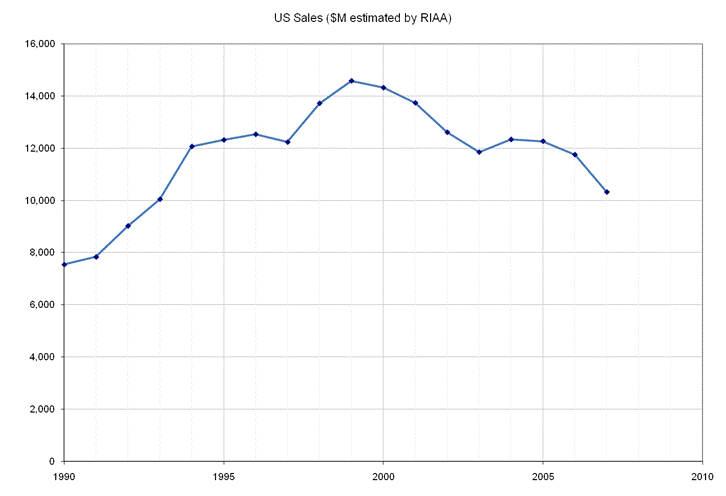
We can start to explore the question of historical sales levels with a set of numbers from the RIAA for the US music market over the period 1990-2005. This illustrates how the US revenue from music has changed over the last 15 years, however this series of data only starts in 1990, much too late to answer our question.
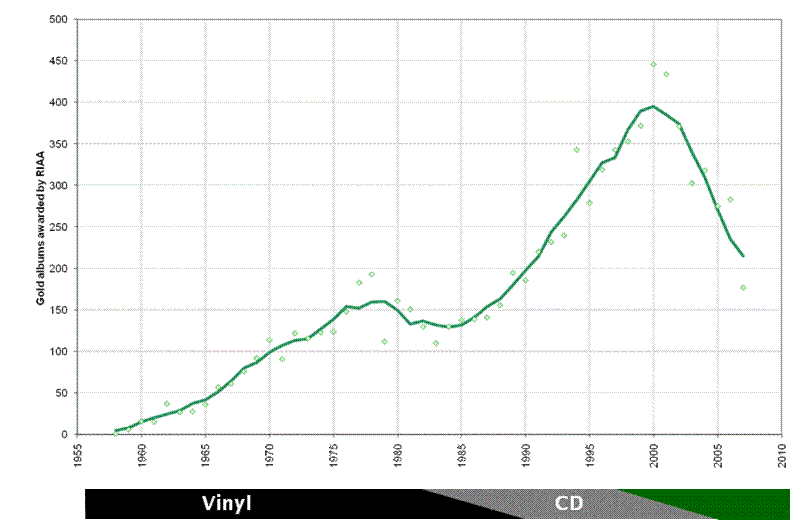
Here is another indicator, the number of Gold disks awarded by the RIAA since 1955. One way to view this says that the number of certified disks in 1970 was roughly half that in 1990 so the ratio of sales should be about the same. Awards are always retrospective, so one might worry that this assumption is too simplistic. However it is reasonable to assume that the rate of new awards in any year is related to the number of candidates passing the threshold for the award within that year, in other words the the number of awards is proportional to sales in that year, even if the bulk of the album's sales were obtained in previous years. In fact it is easy to see that this measure will exagerate the volume of sales as time goes on, since the number of candidates for awards is always being added to.
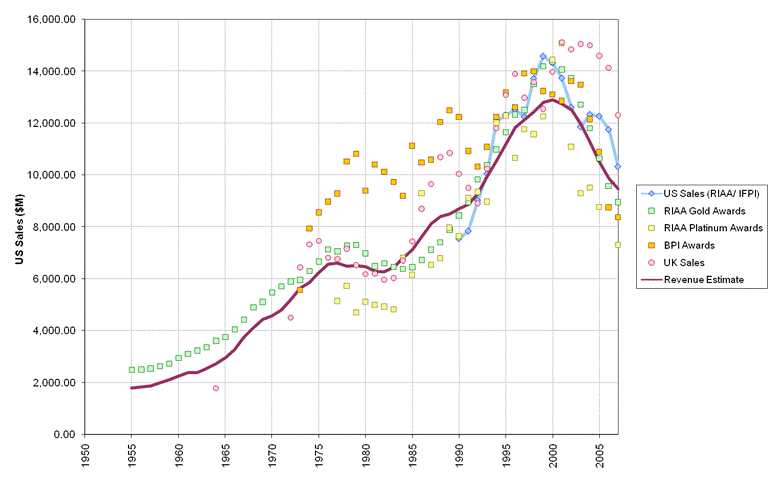
So the sales for 1990-2005 and the number of gold records both help to hint at the trend in market size. Using a combination of other such indicators we can estimate the music market sales for the US for a much longer period.
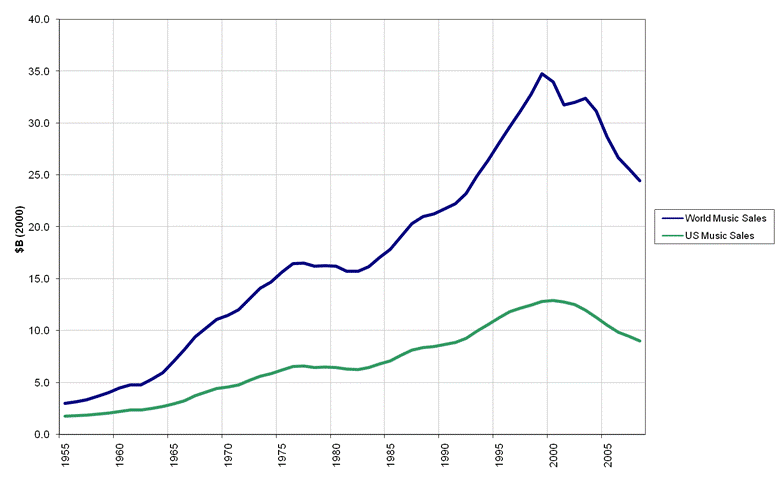
We can make some reasonable assumptions about how the balance of music sales changed from the US led music scene of the 1950s to today's more global market (with the US accounting for just over 1/3 of the sales). This results in the above estimate of the value of the global music market from 1955-2007.
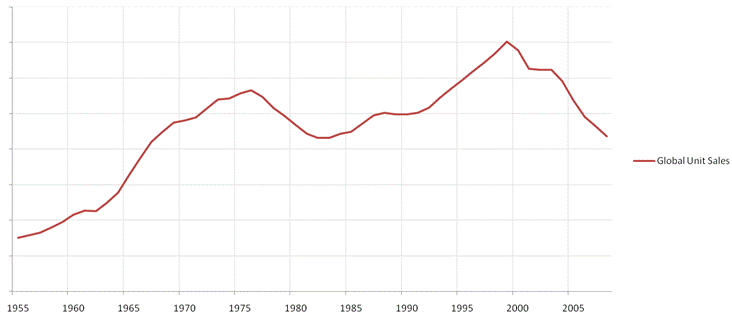
Finally, if inflation and the changing cost of albums is taken into account the above plot shows how the real global music revenue has changed over the last 50 years. There are two factors that complicate the interpretation of the peak between 1970 and 1980, first this era was dominated by the sale of singles rather than albums, and second the adjustment to account for the relative cost of albums may be too severe.
Unit shipment numbers from Japan suggest that contemporary sales of music in the 1960s was between one third and a quarter of the volumes in the late 1990s. For the well-known albums on this list (i.e. ones that continue to sell) it is reasonable to assume that they have doubled this number in the subsequent 40 years.
Taking all these factors into account it is reasonable to suggest that total sales of top hit albums from the late 1960s are at least 50% of those in the 1990s. So we should expect that a "major hit" album of 1965, such as "Rubber Soul" would have something like half the sales of an equivalent album from 1995, like "Jagged Little Pill". However the estimated sales of "Rubber Soul" are less than a quarter of "Jagged Little Pill". This appears to indicate that the low representation in this sales lists of The Beatles (and of course all the other top acts of the 50s, 60s and early 70s) are connected with the process of auditing rather than reflecting the actual sales numbers of their records.
Of course it is interesting to compare this analysis of the global sales with the long term trends that can be seen in the charts.
As with all the complex calculations described on the site you can decide to try out a different approach. If your analysis shows something interesting we will be interested to hear about it.
Source Data
These results were generated from data version 1.8.0065 of the data.
Previous Comments (newest first)
24 Mar 2017
#25 & #105 - Meat Loaf
The Artist on both of these 'Bat Out Of Hell' albums should be 'Meat Loaf' (not Meatloaf).
You are right, we've fixed that name change in all the tables, thanks
3 Apr 2016
BPI updated certs
Here is a full list of recent BPI upgrades
ABBA - GREATEST HITS 8 x Platinum Certification (Album) 05 February 2016 UNIVERSAL MUSIC (POLAR)
PINK FLOYD - THE DARK SIDE OF THE MOON 14 x Platinum Certification (Album) 05 February 2016 WARNER MUSIC (RHINO)
ABBA - GOLD - GREATEST HITS 17 x Platinum Certification (Album) 05 February 2016 UNIVERSAL MUSIC (POLYDOR)
ORIGINAL SOUNDTRACK - GREASE 8 x Platinum Certification (Album) 05 February 2016 UNIVERSAL MUSIC (POLYDOR)
ORIGINAL SOUNDTRACK - SATURDAY NIGHT FEVER 7 x Platinum Certification (Album) 05 February 2016 WARNER MUSIC (REPRISE)
REM - AUTOMATIC FOR THE PEOPLE 7 x Platinum Certification (Album) 05 February 2016 WARNER MUSIC (WARNER BROS)
JEFF WAYNE - THE WAR OF THE WORLDS 9 x Platinum Certification (Album) 05 February 2016 SONY MUSIC (COLUMBIA)
SIMON & GARFUNKEL - BRIDGE OVER TROUBLED WATER 10 x Platinum Certification (Album) 05 February 2016 SONY MUSIC (COLUMBIA)
DIRE STRAITS - BROTHERS IN ARMS 14 x Platinum Certification (Album) 05 February 2016 UNIVERSAL MUSIC (VERTIGO)
U2 - THE JOSHUA TREE 8 x Platinum Certification (Album) 05 February 2016 UNIVERSAL MUSIC (ISLAND)
ORIGINAL SOUNDTRACK - THE SOUND OF MUSIC 8 x Platinum Certification (Album) 05 February 2016 SONY MUSIC (SONY MUSIC)
QUEEN - GREATEST HITS II 13 x Platinum Certification (Album) 05 February 2016 UNIVERSAL MUSIC (VIRGIN)
BOB MARLEY & THE WAILERS - LEGEND 11 x Platinum Certification (Album) 05 February 2016 UNIVERSAL MUSIC (TUFF GONG)
MIKE OLDFIELD - TUBULAR BELLS 9 x Platinum Certification (Album) 05 February 2016 UNIVERSAL MUSIC (VIRGIN)
QUEEN - GREATEST HITS 20 x Platinum Certification (Album) 05 February 2016 UNIVERSAL MUSIC (VIRGIN)
MICHAEL JACKSON - THRILLER 13 x Platinum Certification (Album) 05 February 2016 SONY MUSIC (EPIC)
MEAT LOAF - BAT OUT OF HELL 10 x Platinum Certification (Album) 05 February 2016 SONY MUSIC (EPIC)
WHITNEY HOUSTON - WHITNEY 7 x Platinum Certification (Album) 05 February 2016 SONY MUSIC (ARISTA)
PHIL COLLINS - BUT SERIOUSLY 9 x Platinum Certification (Album) 05 February 2016 UNIVERSAL MUSIC (VIRGIN)
BEATLES - SGT PEPPER'S LONELY HEARTS CLUB BAND 17 x Platinum Certification (Album) 05 February 2016 UNIVERSAL MUSIC (APPLE CORPS)
Thanks for the info but we can't incorporate individual entries we need a complete refresh of the whole chart
1 Mar 2016
RIAA
Your figures are off due to RIAA counting. RIAA doesn't count actual sales--itis albums shipped. Returns are not deducted. An good example is the Eagles, "Long Road out of Eden" is RIAA 7X Platinum. This is shipped LP's. The Eagles had a deal with Wal-Mart and they shipped a ton of Eden CD's. over a third were returned and Wal-Mart took a bath on the deal. It sold probably 4-5 million off the bat. You can't use RIAA to count sales. RCA wasn't a member for many years and no one really knew what Elvis was selling except RCA and the Colonel. After Parker died, it was found he had meticulous records. Sony, who bought RCA, has certified Elvis sold over a billion records and they haven't finished counting overseas yet! The numbers you have are inflated.
That is all explained in the text
5 Feb 2016
UK BPI sales
On 5 Feb 2016, BPI updated cerifications...Pink Floyd, Queen, The Beatles,ABBA, Simon and Garfunkle, Sound of Music, Saturday Night Fever, ...and don't forget Adele
5 Feb 2016
Updates
Thriller now 30x platimun in US....ABBA Gold now platinum x 17 in UK....andBPI now has updates for album sales since 1994...In UK The Beatles Sgt Pepper on Platinum x3, Abbey Road and Revolver platinum x 2
Thanks for the update, when we redo this page we'll take those into account
16 Apr 2015
What's your enmity with MJ?
The certification for Thriller is not 27 x platinum, it's 29. Also Bad'scertification is 9 x platinum and Off the Wall's 8 x platinum. Is it because of the hype that he gets that you can't even get the damn certifications right? Biased crap.
All certifications are from exactly the same time, they are not updated just because biased fans want a better rating. The values given are those that were in effect last time the numbers were refreshed.
We will continue to remain unbiased even if the atrocious attitude of certain fans tempts us to downgrade the object of their affections.
5 Feb 2015
Led zeppelin 4 would have been top if they hyped it up more it went in almost unknown they let the music do the talking. As with thriller it had a massive amount of hype and with the video cast world wide thats how jackson got number one LED ZEPP # is number one
1 Jan 2015
Awards need updating
Hello, you need to update your list with the correct certifications. In the UK, you under-estimate The Beatles, Sgt Pepper is platinum x3, Abbbey Road and 62-66 and 67-70 are all double platinum. Abba's Gold compilation is now platinum x14 now as well. In the US how did you miss Queen's Greatest Hit being 8 times platinum?
UK certifications by the BPI are now based on sales by the Official Charts Company.
Where can we get the complete listing from?
31 Dec 2014
UPDATES
Queen's Greatest Hits is platinum x7 in US you have it without any award! The Beatles Abbey Road, platinum x2 in UK and Sergeant Pepper platinum x3. ABBA's Gold Greatest Hits platinum x14 in uk and gold x10(platinumx5) in Germany...As for The Wall by Pink Floyd (and several other albums) these are double albums. CD releases of this and The Beatles 62-66 and 67-70 are on double CD, sales should be halved in the US. Saturday Night Fever may have a single disc CD but bulk of its sales from 2 disc vinyl. The Eagles you have on 29m in US and 'probable' sales of 43m worldwide. Where are the extra 14m sales?
30 Dec 2014
All Time Best Sellers - Uk
This list, below, is compiled by the official charts company from its own figures and previous chart Compilers, Gallup and the BMRB. The Sergeant Pepper album was released before there were proper sales charts - they were introduced in 1969. In your response to another query you ask why no Led Zep albums - simply because they didn't sell enough to make the All Time Top 40 (there Four Symbols has made it to All Time Top 100). Led Zeppelin and Pink Floyd were more popular in the US than their native UK.
On your global list, how do you get ABBA's Gold on 34m when you have it on just 11.5m for the biggest markets?
The very simple (indeed overly simple) algorithm we used is explained in the text.
However, we still maintain that there are *no* trustworthy lists of album sales (including this one)
30 Dec 2014
major 4 market share
The Top 4 countries -US, UK, Germany and France account for 58.7% of the world's market - where do you get 68% from?
You have two choices, either you count Japan (in which case the four largest markets are 34.8%, 15.4%, 10.5% and 6.8%) so 67.5%.
Or you reduce Japan to (say 2%) in which case the four you mention do add to 58.7 but you must *also* reduce the overall market total (because Japan is losing 13.4 so the overall total decreases) and 58.7 is 67.78% of 86.6
And all the numbers are approximate anyway
29 Dec 2014
Double Counting
The Wall by Pink Floyd has not sold 23m in the US - 11.5m. Double albums are double counted! You should take account of this. Other double albums include the Beatles Red and Blue Albums and indeed the White Album, Saturday Night Fever, Grease etc.
The text on the page dicusses this
29 Dec 2014
BPI Updates
As you know the UK didn't start awarding gold or platinum discs until 1973. However, in 2009, rules were changed and certifications were 'automatic' based on sales by the Official Charts Company (from 1994 onwards). Older albums were allowed certifications for sales since 1994. The Beatles' Sgt Pepper is now platinum x3 for its sales in the past 20 years. By the way, ABBA's GOLD is platinum x14 now.
29 Dec 2014
US sales can distort estimates
Hi, I like your site. However, I think you are over-estimating some album sales eg Eagles, Shania Twain, and Meatloaf which sold disproportionately in the US. Outside the US, the Eagles didn't sell much but the massive sales there are distorting your estimate.
Why can't you use Official Charts Company or Soundscan figures? These are official chart compilers.
Did you read the text on this page? It explains why we don't trust figures from those sources (even where they have them), and also why no-one should trust the figures from this page either
15 Nov 2014
Brandy's Never Say Never is missing in the list
Brandy's Never Say Never sold 16 million copies.
As the text says this list doesn't include all the albums that had these sales levels, only those that have particular evidence available.
14 Aug 2014
White album
The Beatles' White album is not here despite being 19 Platinum (9.5 million copies) in the US, Platinum (300,000 copies) in the UK and Gold in France.
Also, you seem to be treating double albums like regular albums. For example,The Wall is 23— Platinum in the US but as it is a Double album it has actually only sold 11.5 million copies on the US. You do not seem to take this into consideration, as you have treated the Beatles' Red and Blue albums the same way.
"The Beatles (The White Album)" should be in the list, we don't know why its missing. We will find out what is wrong and fix it, thanks for drawing that to our attention.
The strange double album counting that is unique to RIAA is explained in detail in the text on this page. Your suggestion that sales of double albums should all be halved is a little too simple. For some releases (such as "Saturday Night Fever") some formats (such as the LP) were double (and counted twice) while some (such as the CD) were single so were not counted twice.
Since these numbers are all unreliable estimates anyway (as we explain in the text), we made a decision to just treat the RIAA data as though it wasn't stupidly defined.
5 Aug 2014
Singles
Is there a similar thing you could do that would involve singles sales rather than albums?
Unfortunately there is not enough trustable data for the periods when singles were the major way that music was distributed (approximately the 1950s-1970s).
30 Jun 2014
none
Thank God Miley Cyrus, Justin Bieber & Nikki Manaj didn't make this list. Faith in Humanity restored.
You mean didn't make this list... yet
20 Jun 2014
vinyl LPs - gold and platinum
Do you have any information on gold and platinum albums by format type? (e.g. vinyl LPs vs. CDs). I am doing some research on the recent resurgence of vinyl and interested in how many albums are released on vinyl and what proportion of these were also gold/platinum albums.
BTW, wow - you have compiled a LOT of great industry data and analysis. Thank you for sharing this and for including your sources.
There is very little reliable data we have found on historic sales levels by format. The best source we ever got was the "RIAJ YEARBOOK 2007", which lists sales volumes by format from 1929-2007, but only for Japan.
Detailed sales levels are currently collected, but getting hold of that data after 2005 usually requires paying for it (and then of course we couldn't share it)
If you find any reliable data for total sales levels (anywhere) from before 1990 please tell us.
26 Apr 2014
Sgt Pepper's Lonely Hearts Club Band
Has Sgt Pepper's Lonely Hearts Club Band really only sold 17 million copies? I have seen estimates of up to around 30 million, and it is often said to be the Beatles highest selling album. I see you have not given a British certificate for it. According to the UK charts, it has sold 5.1 million copies in the US, which I believe means it is 17X platinum.
http://www.officialcharts.com/chart-news/the-official-top-40-biggest-selling-albums-of-all-time-2288/
The calculation on this page uses a conservative estimate with only a fixed set of data sources. If you read the text we suggest that the method used clearly underestimates sales of albums from the 1960s. Our best guess would be that the actual number is in the range 32-60 million sales, but that is based on subjective factors, so we don't use that number here.
The list you point to is interesting, but since no sources are provided its hard to verify. Why, for example, are Led Zeppelin's albums not on the list (I know they sold in the UK, not just the US).
31 Mar 2014
iron maiden
Iron Maiden
6 Jul 2013
music
Where is Billy Idol!
His best rated (for this list anyway) album "Vital Idol" only has US Platinum, UK Platinum and Germany Gold, way short of the total required to make this list.
15 Feb 2013
Scorpions?
What about Scorpions? LOVE AT FIRST STING > 9.000.000 CRAZY WORLD > 15.000.000 1972-1979: > 11.000.000 1980-1989: > 33.000.000 1990.1999: > 29.500.000 2000-2009: > 9.000.000 ------------------------------------ > 82.500.000 + + the singles(still loving you,Rock you like a hurricane,wind of change....etc. +compilations,live albums? They should be on some of your chart!
9 Feb 2013
Live - Throwing Copper
This album has a shot at 10M don't you think? It sold about 8M in America only... that's a "minimum" of 8M...
Also you put Counting Crows' August album but it probably sold less than Live's.
We suspect you are right, but we follow a fairly simplistic route to get to our numbers, no "reasonable tweaking" is allowed here
5 Feb 2013
Iron maiden sales
These are the actual Iron maiden sales As of Jan 2012
1.Iron maiden - 5 million 2.Killers ++ +- 6 million 3.Numner of the beast - 14 million 4.Piece of mind -+ 8 million 5.Powerslave ++ -+ 7 million 6.Somewhere in time - 6.5 million 7.Seventh son of a seventh son - 7 million 8.No prayer for the dying - 6 million 9.Fear of the Dark -+ 5 million 10.X factor +- 1 million 11. Virtual XII - 0.75 million 12. Brave new world - 4 million 13. Dance of death +- 3.5 million 14. A matter of life and death - 4 million 15. The final frontier -+ 3 million
Live Albums Live after death - 8.5 million Maiden england + - 1.5million A real live one +- 2 million A real Dead one +- 1 million Rock in Rio ++ + - 1 million Death on the road - 1 million
Compilations Best of the beast - 3 million Edward the great +- 1 million Somewhere in time - 1.5 million
Their certifications Only support 20 - 25% of their total sales, which is mainly because they were a non- commercial band,However their high grossing tours, Eventually made many sales statistics information collectors collect a detailed info on their sales. The only eact sales certifications they got was the RIAA certifications.
Their sales in europe are far more than the sales indicated in certifications.
Powerslave, Live after death, NUmber of the beast eventually sold 2 million copies in the US. But they were never certified as double platinums.
Iron maiden are one of the very few bands, and as far as i know the only band to achieve high sales as a non commercial band.
We don't trust sales figures from anyone (even ourselves).
I do remember taking a guy in a wheelchair to a gig of theirs on Holloway Road in early 1979 (SteveH)
27 Jan 2013
SCORPIONS
crazy world from scorpions sold around 11-12 million in the world .... can you find if its true and by the way since im here ehheeheh can you know the sales from scorpions
cheers from Portugal
Nuno Nabais
We don't trust any claims of "worldwide sales" (even our own). So our answer would have to be we don't know
24 Jan 2013
The Beatles
It always amuses me that Michael Jackson fans think that MJ was the biggeststar in music. And yet, he was not. His sales began to decline after the early 90s, and if it was not for his death, those sales would remain in decline. However, the Beatles continue to sell to each new generation as if they were a new act. Every several years there appears to be a new wave of Beatlemania sales. Great music will live forver.
18 Nov 2012
Robbie Williams
Hi could i know once for all how many records has sold TO date? Thanks
You can't. The real answer is no one knows.
3 Nov 2012
Mariah Carey sales far from the correct values
Hello, I'm writing this email as I was really surprised with some of the chart's numbers. Starting by saying that Bodyguard has is the best selling album for a female artists and being the only one achieving the 40 M rank.
Music box and other albums come pretty even with around 30 M. Would also like to clarify that Mariah Carey sold 17 M, Butterfly sold 18 M, Emancipation of Mimi around 14-15 M by now, Rainbow around 9-12 M, the Unplugged album sold above 15 M , the Emotion Cd sold 8 M, +charmbracelet 4 M, Glitter around 3 M ...please check your numbers
You are not reading what has been written. First of all our estimate for "The Bodyguard" is 37.3 million. "Come On Over" by Shania Twain has an estimate of 42.7 (and last time we checked Shania Twain was female).
Your other numbers are both unlikely and, since they are not sourced at all, should be ignored.
And finally you should have seen our comment "quoted sales figures are inherently untrustworthy and should normally be treated with extreme caution" and "we don't trust even our own listing of sales numbers".
19 Oct 2012
"Queen's Greatest Hits I"
You should update the US certifications and total sales for Queen's "Queen's Greatest Hits I".
Here's the link to the RIAA certification: http://www.riaa.com/goldandplatinumdata.php?artist="queen"
(Click on "award description" twice)
11 May 2012
Underestimating sales
For the next time you update the list, I sincerely think you could improve your estimates for newer albums by including IFPI Platinum Europe Awards in your certifications for albums released later than 1994.
For example, "21" has a 8x Platinum (8 million) award in Europe, which combined with the new 9x Platinum certification for the U.S., 12x Platinum in Australia (0.84 million), Diamond in Canada (0.8 million), 4x Platinum in Mexico (0.24 million) and 10x Platinum in New Zealand (0.15 million), suggest sales of AT LEAST 19 million worldwide.
Here is the list of albums with the highest IFPI Platinum Europe awards://es.wikipedia.org/wiki/IFPI_Platinum_Europe_Awards#.C3.81lbumes_con_mayor_cantidad_de_certificaciones
Thanks for the link. We will review the source data that best matches next time we update this list.
19 Apr 2012
Adele -21
I've taken a look at the certifications for Adele's "21", and they seems to be: 8x Platinum in the U.S., 15x Platinum in the U.K., Diamond in France (0.5 million) and 6x Platinum in Germany (1.2 million).
Surely that is enough for the album to be added to this list, right?
Next time we update this list it will no doubt be there. However we only get new certifications every few years (our focus is on older music)
Since you can see the factors we use (explained in the text) your numbers would give total sales of 14.2 which would place it at 162 in the list.
25 Feb 2012
BAD WAS THE SECOND BIGGEST SELLING ALBUM
I saw where you guys told someone that MJ's album BAD wasn't the second biggest selling album. During the 80's decade, it was said that BAD was the second biggest selling album right behind Thriller. Now it's not the second biggest selling album of all time, but during the 80's it was the second biggest selling album.
"Bad" was 8xPlatinum in the US in 1994. Eagles album "Eagles' Greatest Hits 1971-1975" was 29xPlatinum for an album released in 1976. The albums "Four Symbols (Led Zeppelin 4)", "The Wall" and "Rumours" were all released in the 1970s and have considerably higher overall sales than "Bad".
If you had misread the original claim and you thought that "Bad" was the second highest selling album of the 1980s then look at AC/DC's "Back In Black" released in 1980, 22xPlatinum in the US. Also "Brothers In Arms" and "Billy Joel's Greatest Hits, Volume I & Volume II" both released before "Bad" and have much higher overall sales.
These numbers are consistent across the whole world (we just used the US figures because they are easy to validate)
So sorry but the claim that "Bad" was ever the worlds second highest selling album is just wrong.
8 Feb 2012
bon jovi
I would like to know the selling datas of bon jovi's albums keep the faith and these days. thanx a lot
Details of both these albums are on the Bon Jovi album page. For example "Keep The Faith" was 2 Platinum in the US, and Platinum in the UK, and Germany. We feel that this does not give enough information to estimate total sales (which we would guess at 3 - 7 million).
Our suggestion would be that you look at the confirmed chart information (listed on the Bon Jovi album page) and make your own mind up. Armed with that data your guess would be at least as good as ours.
31 Dec 2011
Iron Maiden
I would like to know where you are getting the record sales for Iron Maiden...
The following Iron Maiden albums sales are what I believe to be true (worldwide sales):-
1. Iron Maiden (1980) - 10 million 2. Killers (1981) - 10 million 3. The Number of the Beast (1982) - 20 million 4. Piece of Mind (1983) - 15 million 5. Powerslave (1984) - 20 million 6. Somewhere in Time (1985) - 20 million 7. Seventh Son of a Seventh Son (1987) - 10 million 8. No Prayer for the Dying (1990) - 10 million 9. Fear of the Dark (1992) - 10 million 10. The X Factor (1995) - 3 million 11. Virtual XI (1998) - 2 million 12. Brave New World (2000) - 5 million 13. Dance of Death (2003) - 5 million 14. A Matter of Life and Death (2006) - 5 million 15. The Final Frontier (2010) - 5 million
Total - 150 million studio album records sold worldwide. And if you add all the live albums (e.g., Live After Death, Rock in Rio) and compilations (e.g., Best of the Beast) to that... they have easily sold 170 million records worldwide.
Please let me know if there are any real facts about Iron Maiden's album record sales. Thank you and up the Irons.
As we've said before we base the estimates on these pages ONLY on certifications that we have extracted directly from the official sites. We then do the simple calculation which is explained above.
We continue to believe that there are NO estimates of album sales that should be trusted (and in that we include our numbers on this page)
7 Dec 2011
Dobry blog
Dzieki za ciekawy blog
28 Nov 2011
Guns N Roses Greatest Hits
hi, just wanted to say I think GNR's greatest hits how has a certification in the USA of 5x Platinum.
17 Nov 2011
sales of Thriller (RIAA updated)
Hello, I just thought I'd mention that the RIAA certification for Michael Jackson's Thriller has been updated to 29x platinum. This is obviously due to the sales increase following his death and so I think it's also possible his other albums have been recertified although I haven't checked.
The same is probably true for the other major markets such as the UK, so it's probably worth checking those certifications too.
Regards,
Chris.
Thanks for the update, we only invest the time required to extract and consolidate the RIAA chart as the listing becomes well out of date, but next time we do that this data will be incorporated.
14 Sep 2011
A few observations
Hello:
I saw in the list Shakira's album "Fijacien oral" that its certified 8 times platinum in the US, but I think it refers to a category especificaly for the latin market inside the US, where every gold certification counts as 100,000 copies and every platinum certification counts as 200,000. So it would be 1.6 million copies rather than 8
You are correct in suggesting that the RIAA has a special category for Latin albums with lower thresholds.
Unfortunately the RIAA site lists these awards as "Platinum" rather than what they are which is "Los Premios de Platino" which makes it impossible to tell which records have Latin awards and which ones the more significant numbers.
Since we cannot tell the difference we will just have to treat this as yet another reason not to trust sales numbers.
29 Jul 2011
Phil Collins
Is there really a serious possibility that 'No jacket required' has sold somewhere over 30 million copies and 'but seriously' somewhere 30 mill near?
As we say at the top of this page this is an attempt to estimate based on the few reliable sources we have. We explain the approach we've taken and given that way of estimating.
The actual estimates are below 30 million for both of them.
The estimate here is 24-34 million for "No Jacket Required" and 19-30 million for "... But Seriously". Given that "No Jacket Required" sold three times as many copies in the USA, and "... But Seriously" sold more copies in Europe we still think that these are reasonable ranges.
27 Jun 2011
Goodbye Yellow Brick Road
Why everywhere else if you look Elton John's 'Goodbye Yellow Brick Road' ismentioned to have worldwide sales of at least 31 million copies? If that's true it makes it easily to the top ones.
First of all let us say that we don't trust any claimed estimates for albums (we don't even really trust the ones on this page). The number of 31 million is claimed in a number of places but we don't see any credible source for it.
The next point is that 'Goodbye Yellow Brick Road' is a double album, some certification authorities (and for some periods) counted each sale twice for double albums, so in the US where a million copies would be needed to get a Platinum for a single album only half a million copies would be needed for a double album. Confusion about when this rule held, and how it was applied have led some sites to double (or half) the estimated number of sales of some double albums.
The largest market in the world is the USA. RIAA certified 'Goodbye Yellow Brick Road' as 7 x Platinum in 1998. One would expect that total worldwide sales would be about 3 times that level, that is about 21 million copies 13 years ago. Our estimate is well below that figure because, like many albums of the 1960s and 1970s, the album was not certified in France and Germany (or recently in the UK). As we explain in the text this lack of evidence for older albums reflects a lack of interest by the record companies in paying for the certification, and cannot be taken to prove a lack of sales.
So our guess as to the sales would be somewhere about 25 million copies or so (21 million in 1998 plus an extra four million since then). A total of 31 million would require some kind of major boost in recent sales (in the same way that "Thriller" sold a lot of copies in 2009 because of the singer's death). We can't see any reason to believe that this has occurred.
So we would agree that the number calculated here is too low, but 31 million seems too high to be believable.
7 Dec 2010
all time album sales
I see you have led zepp 4 number 2 on your list , I think you have to add me buying lz4 to your list , since I have been buying that album for the last 6 to 8 months , I have bought 53 of them.
7 Dec 2010
albums of all time sale
Why is sales numbers of all time sales differ then wikipedeida sale numbers of all time , whats going on here. Is anybody keeping with sales numbers , that they give you
There are two different issues here, first of all at least some of the the sales numbers on Wikipedia are clearly wrong. They are quoted without giving reliable sources and are edited by people that have an interest in distorting the numbers.
One of the reasons for having this data available in this form is to counter the completely blatant lies that certain editors have placed on Wikipedia (and have repeatedly reinserted when reasonable people try to correct).
Secondly, as the text on this page indicates, the numbers here have been calculated based on certification data. The source data we have is reliable, but clearly incomplete. For example we cannot find available data for the French certificates before the early 1990s. We take that reliable data and apply a simple calculation, which is clearly described in the text above. This approach is good enough to clearly show, for example, that "Thriller" could not possibly have sold more than 100 million copies. We have put a range in to indicate the uncertainty in our numbers.
So in summary, the album sales data on Wikipedia is wrong. The data here is wrong, but less wrong than the Wikipedia data. If anyone claims to know the correct worldwide album sales numbers they are lying to you.
29 Nov 2010
Europe:The Final Countdown
The final Countdown sold around 8 million. Why is there not on this list?
The albums in this list are all estimated to have had sales of at least 10 million. Sales of 8 million wouldn't be enough to get listed.
The album "The Final Countdown" was 3 X Platinum in the US, achieved a Gold in Germany and (in the lists we have access to) was not classified in the UK or France. Based on those figures we would guess total sales of 4-7 million.
8 million is possible but its at the very top end of the range. And as we said 8 million is too few for this list.
9 Sep 2010
IRON MAIDEN
IRON MAIDEN RULES AND THE US DOESNT EVEN ACKNOWLEDGE THEM ON THIS LIST AND THEY DON'T CARE
30 Dec 2009
LAUNDRY SERVICE SHAKIRA
Where's "Laundry Service" by Shakira? It sold 20 million copies.
Looking at the album page for Shakira we can see that it was certified as US 3 x Platinum, UK 2 x Platinum, France 2 x Platinum, Germany 2 x Platinum.
Which means it had sales of at least 4.4 million, and by our calculations probably sold 12.8 million (with an estimated range of 10-16 million sales).
By these numbers the album should be on this list. However this English language album was originally known as "Servicio De Lavanderia" in France, so when the list was calculated the French numbers were omited and the resulting estimate of 9.9 million sales was below the cut-off. This mismatch has now been fixed, so next time list is calculated it will be included.
Sales of 20 million are much higher than our estimate. And the fact that both BMI and Shakira's own web site (at www.shakira.com) estimate sales as "more than 13 million". Which seems very reasonable.
So we think that 20 million copies is so much of an overestimate it is clearly wrong.
2 Dec 2009
Genesis biggest seller
Hi I read with a friend of mine on a website that Genesis highest selling album is not We Can't Dance it is actually Invisible Touch. It looks like to me that your numbers and maybe statistics are outdated. We Can't Dance sold 22,000,000 copies worldwide and went 4 times platinum in the U.S. and Invisible Touch went 6 times platinum in the U.S. and has sold 24,000,000 copies globally. I even read on the VH1 website that Invisible Touch is Genesis highest selling pop album to date.
Thanks Aaron Wake
First of all thank you for your input. Of course most of the lists on this site measure success in the charts round the world and not sales. So, for example, the 1983 album "Genesis" lists higher than "Invisible Touch" because it was a hit in more countries, but it is fairly certain that its sales were lower.
Claims of worldwide sales on web sites are generally not trustworthy, for example on Wikipedia look at the number of page modifications and the length of discussions on all pages that mention sales numbers. The issue is that there are no validated worldwide sales numbers so every group of fans use their own approach to estimate numbers.
We do have a page that lists our estimates of sales numbers. We use a combination of the certification levels from the US, UK, France and Germany (the four biggest markets). That page describes how we combine those numbers to estimate worldwide sales. It also explains why we don't trust even our own listing of sales numbers.
The two albums you mention are listed on that page. Your numbers for the US sales are correct, however you don't list the fact that "We Can't Dance" was also 5xPlatinum in the UK and 5xPlatinum in Germany, while "Invisible Touch" was 4xPlatinum in the UK and 1xPlatinum in Germany. "Invisible Touch" was more successful in the US, however the certifications and chart positions show that "We Can't Dance" was clearly a bigger hit in Europe.
Our estimate is that "We Can't Dance" sold 15-24 million worldwide and "Invisible Touch" sold 12-17 million.
We don't know where VH1 got these numbers from, however we have seen other occasions when VH1 has over emphasised acts that were successful in the US and ignored acts that were hits anywhere else in the world. This is one of the reasons why we don't use any of their charts in this site.
So, we believe that the balance of evidence suggests that "We Can't Dance" sold more, however the wide margin of error leaves the question open. We also have learnt that you should not trust any website that lists worldwide album sales numbers (even our own).